4 Essentials for Real-Time Fleet Visibility in Truck & Civil Fleets

Real time fleet visibility gives you live vehicle positions, instant alerts, and one unified dashboard instead of end-of-day reports. That immediacy changes two things straight away: dispatch decisions get faster because ETAs are accurate, and your office stops fielding “where’s the truck” calls because customers and staff see the answer themselves. Platforms like Dirt Champ deliver this by pairing GPS tracking with the field records that already run your operation.
TL;DR:
- Fleet size beyond 20 to 30 vehicles requires clustering on the map to maintain clarity during peak operational hours.
- High-frequency GPS updates using multiple satellite systems are essential to ensure accuracy in urban and challenging environments.
- Linking real-time location data with pre-existing operational records streamlines billing, compliance, and site activity monitoring.
- A pilot program on a subset of vehicles over several weeks helps identify data quality issues before a full rollout.
- Focusing on key KPIs like uptime, on-time performance, and utilization prevents alert fatigue and ensures timely responses.
Table of Contents
- What is real time fleet visibility?
- What features make live fleet monitoring actually work?
- How does real-time visibility improve day-to-day operations?
- How do you plan a real-time tracking rollout?
- Which KPIs and alerts actually matter?
- Dirt Champ: real-time visibility built for truck and civil operations
- When should you pilot versus commit to a full rollout?
- Ready to bring your trucks and machinery onto one screen?
- Sources
What is real time fleet visibility?
Real time fleet visibility means continuous streaming of location and telemetry data, not a snapshot pulled every few hours. The difference sounds small until you’re the one making a call with stale information.
Periodic tracking gives you where a vehicle was ten or thirty minutes ago. Real time systems tell you where it is now, and that gap matters most when a customer is on the phone asking for an ETA or a truck has stopped moving on a job site. Decision latency drops from “check back later” to “look at the screen.”
The data flow behind this is simple in concept:
- A device on the vehicle (or a mobile app) captures location and telemetry
- That data streams to a cloud platform, typically every few seconds to a minute
- The platform pushes it to a live map, dashboard, or API for dispatch, compliance, and billing systems to use
Fleet tracking solutions built this way turn a location ping into an operational signal, not just a dot on a map.
What features make live fleet monitoring actually work?
A live map is only as useful as what sits underneath it. Four building blocks separate a genuine real-time system from a glorified GPS logger.
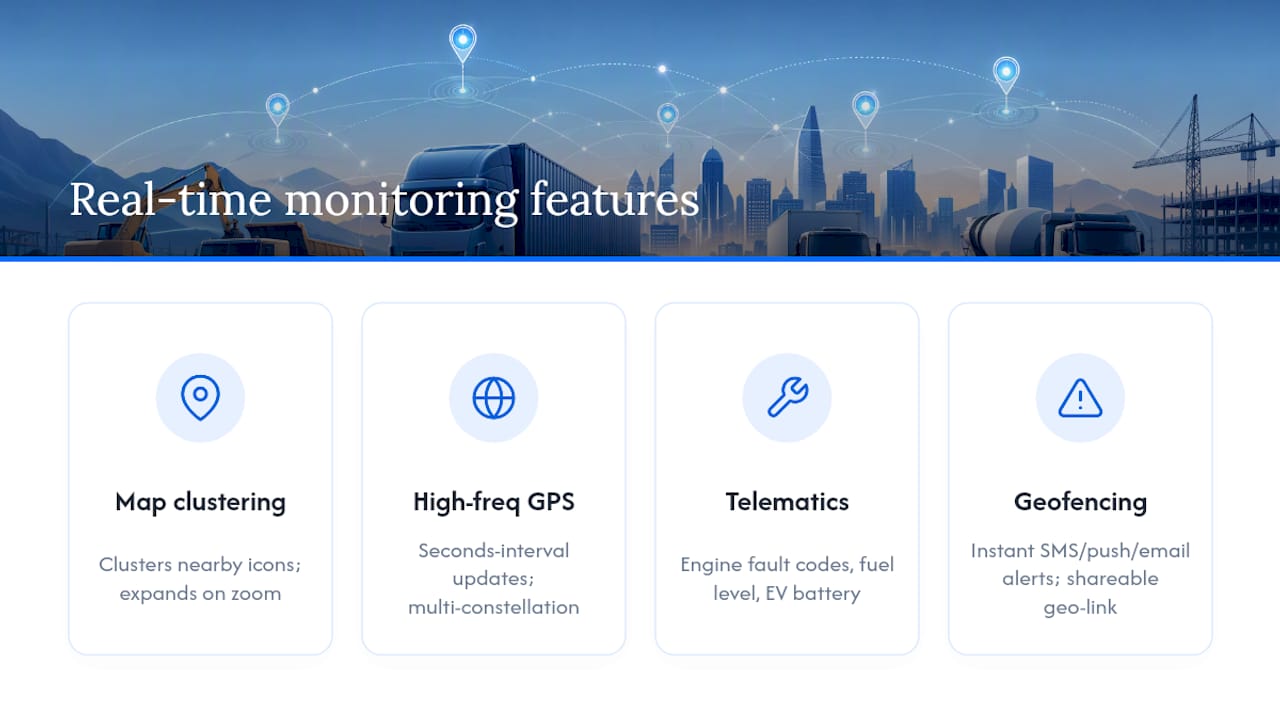
Live map visualisation with clustering. At scale, dozens of overlapping vehicle icons become unreadable. Automated clustering groups nearby vehicles and expands them on zoom, which keeps the map usable instead of turning into visual noise that hides the one alert that actually matters.
High-frequency GPS with multi-constellation support. Updates every few seconds, drawing on GPS plus other satellite networks, keep positioning accurate in built-up areas and dead zones where a single-constellation receiver drifts or drops out.
Telematics and diagnostics. Engine fault codes, fuel level, and battery state on EVs turn a tracking system into a maintenance early-warning tool, not just a locator.
Geofencing and multi-channel alerts. Instant notifications by SMS, app push, or email fire the moment a vehicle enters, exits, or idles somewhere it shouldn’t, with a shareable geo-link so a customer can watch the approach themselves.
Trailer and asset sensors round this out for anyone running plant, machinery, or towed equipment alongside trucks.
Pro Tip: If your fleet is past 20 to 30 vehicles, ask any vendor how their map handles clustering before you sign anything. Without it, the busiest hour of your day is exactly when the dashboard becomes hardest to read.
How does real-time visibility improve day-to-day operations?
Vehicle location tracking earns its keep in the moments where a delay costs you money or trust. Here’s where the gains show up concretely:
- Dispatch and ETAs. Live positions let allocators assign the closest available vehicle instead of guessing, and accurate ETAs mean fewer status calls. Some operators report cutting status-call volume by as much as 80% after automating updates and sharing geo-links with customers.
- Maintenance and uptime. Streaming diagnostics surface fault codes and unusual idle patterns before they become a roadside breakdown, letting you schedule a fix instead of paying for a tow.
- Safety and compliance. Instant alerts on harsh braking, speeding, or route deviation give supervisors a chance to intervene, and the same location trail doubles as proof of service for a client dispute.
- Asset utilisation. Seeing which vehicles sit idle and which are overworked lets you reallocate instead of buying another truck you didn’t need.
Delivery fleets use this for accurate customer ETAs, service fleets for faster technician dispatch, construction and civil operators for site activity and plant tracking, and passenger transport for live arrival updates. ConnectedFleet’s guidance from Michelin points to proactive monitoring and preventative maintenance as two of the fastest wins once visibility is in place.
How do you plan a real-time tracking rollout?
Most rollout failures trace back to decisions made before installation day, not the technology itself.
Match update cadence to the job. Live dispatch and customer-facing ETAs need positions every few seconds. Strategic fleet oversight, where you’re checking trends rather than chasing a truck, can run on 30 to 60 second intervals and save on data costs without losing operational value.
Pick the right device type. OBD-port devices install in minutes and suit fleets wanting fast deployment without workshop time. Hardwired telematics units offer deeper diagnostic access for heavy vehicles and plant. Mobile apps work for light vehicles or contractors where hardware installation isn’t practical.
Check your integration list before you buy. Dispatch software, payroll and rostering, maintenance scheduling, and billing all benefit from a connected feed, so confirm API access covers each of these rather than assuming it does.
- Connectivity design: plan for SIM roaming, offline data logging in dead zones, and backup connectivity
- Data governance: set clear rules on driver privacy, data retention periods, and how you’ll communicate monitoring to staff
- Pilot scope: test on a representative vehicle subset, track on-time performance and idle time, and set go/no-go criteria before you expand
A pilot running on a representative subset of vehicles over several weeks is usually enough to expose data-quality issues and inform rollout decisions, like GPS drift in a depot with poor satellite line of sight, before you commit fleet-wide.
Which KPIs and alerts actually matter?
Tracking everything is the same as tracking nothing. Five metrics cover most of what a fleet manager needs day to day:
- Live uptime — the percentage of vehicles reporting data as expected
- On-time performance — arrivals against scheduled or promised windows
- Idle minutes — time spent stationary with the engine running
- Utilisation rate — active hours against total available hours
- Mean time to repair (MTTR) — how fast a flagged fault gets resolved
Alert routing matters as much as the alert itself. Send geofence breaches and safety events to dispatch in real time, send maintenance codes to the workshop, and save low-priority pattern data for a daily or weekly report. Route everything to everyone and you get alert fatigue, where the one alert that matters gets lost in fifty that don’t. Keep the live dashboard for what needs action now, and let periodic reports handle the trends worth reviewing at the end of the week.
Dirt Champ: real-time visibility built for truck and civil operations
Most fleet tracking tools are built for general logistics and bolted onto construction or civil operations as an afterthought. The platform connects trucks, machinery, project records, and compliance documentation into one platform, with GPS tracking that integrates without complicated installation.
That matters because location data on its own doesn’t fix a paperwork bottleneck. Linking real-time position to the pre-starts and dockets your drivers already fill out closes the loop between “where is the truck” and “what did it actually do today.”
- Live GPS tracking via OBD port, avoiding hardwired installation delays
- Digital pre-starts and dockets tied to real-time site activity
- Automated compliance and safety document management
- Tools and asset tracking alongside vehicle location
| Operational gain | How it shows up |
|---|---|
| Faster invoicing | Site activity and dockets feed billing without manual reconciliation |
| Simplified compliance | Safety and compliance records sit alongside location data, not in a separate system |
| Live site oversight | Supervisors see real-time activity across trucks and machinery on one screen |
When should you pilot versus commit to a full rollout?
Pilot first if you’re running more than a handful of vehicles or if drivers have never worked with tracking before. Buy outright only if you’ve already validated the workflow on a smaller scale elsewhere.
Two moves make the difference: run a 30-day pilot on a representative subset of vehicles, and build an alerts playbook that maps each alert type to the role that should act on it. If you want to see how that looks in practice, Dirt Champ’s platform is worth a look before you lock in a full deployment.
— Mike
Ready to bring your trucks and machinery onto one screen?
If you’ve been juggling a separate GPS tracker, a paper docket book, and a spreadsheet for compliance, you already know the real cost isn’t the tracking, it’s the reconciliation afterwards. Dirtchamp was built specifically for truck and civil businesses to close that gap: GPS tracking integrates via the OBD port without a complex install, and it plugs straight into the pre-starts, dockets, and compliance records your crews already complete.
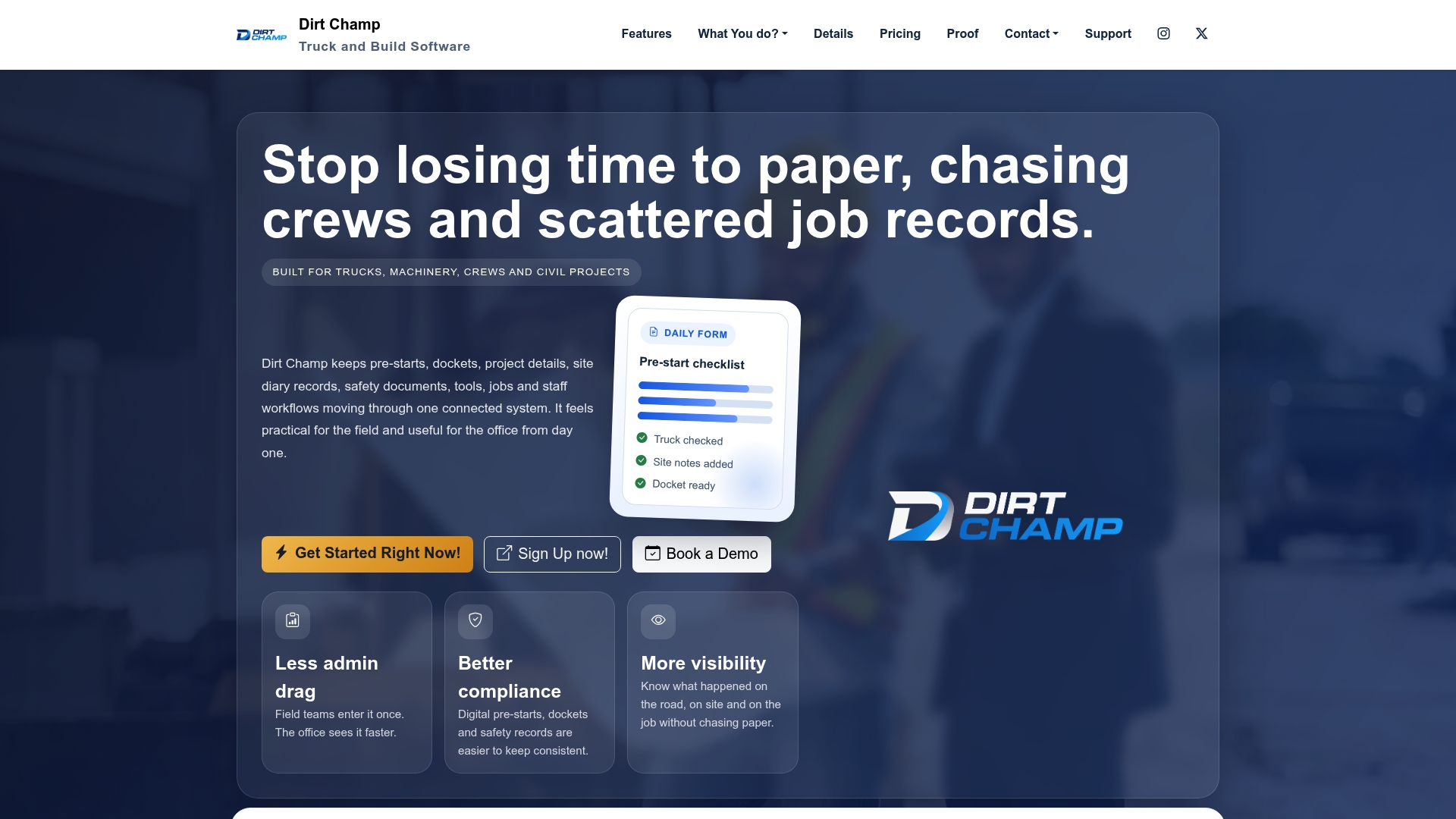
That means real-time site activity feeds directly into billing and compliance instead of sitting in a separate app nobody checks. If your office is still chasing paper dockets to match against a GPS log at the end of the week, that’s the exact workflow Dirtchamp replaces. Head to Dirt Champ to see the platform and book a demo suited to your fleet size.