Near miss reporting for safety managers and supervisors

Near miss reporting is the formal recording of a close call that could have caused injury, illness or property damage, but didn’t. The moment one happens, three things need to occur: make the area safe, capture the evidence before it disappears, and get the event on record. Under ISO 45001 and OSHwiki, a near miss falls inside the broader “incident” definition and deserves the same disciplined analysis as an event that caused actual harm. A tool like Dirtchamp can help crews log the details from a phone before memory of the exact circumstances fades.
- Preserve evidence – photograph the scene, note equipment IDs, and get GPS or location details before anything moves.
- Ensure safety – isolate the hazard or make the area safe so nobody else walks into the same situation.
- Record the event – get a written or digital record started within hours, not days.
Pro Tip: Treat the first ten minutes after a near miss the same way you’d treat a genuine incident. Evidence degrades fast, especially witness memory and site conditions.
Key Takeaways
Effective near miss reporting depends on fast evidence capture, a non-punitive response from supervisors, and clear escalation rules for high-potential events.
| Point | Details |
|---|---|
| Definition matters | A near miss involves no harm; an incident or accident involves actual harm or damage. |
| Act in the first minutes | Make the area safe, capture photos and GPS, then start a written record. |
| Assign a receiver | Name a responsible person and a backup to collect and action every report. |
| Prioritise high-potential events | Reserve formal root-cause analysis for the events that could have caused serious harm. |
| Use a mobile-friendly tool | Dirtchamp lets crews log near misses from the field with GPS stamping and compliance integration. |
Table of Contents
- What counts as a near miss on a worksite?
- Why should you bother recording near misses?
- Who is responsible for reporting a near miss?
- How do you report a near miss step by step?
- What should a near-miss report actually include?
- How do you investigate and follow up on a near miss?
- How do you get workers to actually report near misses?
- What tools work best for capturing near-miss reports?
- How do you train workers to spot and report near misses?
- How does near-miss reporting fit into your broader safety system?
- What stops people from reporting near misses, and how do you fix it?
- Where to find more guidance on near-miss reporting
- What actually moves the needle on near-miss reporting
- Get near-miss reporting off paper and onto the phone
- Frequently asked questions about near-miss reporting
- Sources
What counts as a near miss on a worksite?
A near miss is an unplanned event with the potential to cause injury, illness or damage, but where no harm actually occurred. An incident or accident, by contrast, involves actual harm, damage or loss. The distinction sits entirely on outcome, not on how close the call was. A load that shifts and nearly crushes a foot is a near miss; a load that shifts and does crush a foot is an incident.
Common examples supervisors will recognise:
- A grinder disc shatters but the guard deflects fragments away from the operator.
- A truck reverses toward a worker who steps clear at the last second.
- A worker slips on a wet ramp but catches the handrail before falling.
- An excavator bucket swings within centimetres of an overhead power line.
- A worker steps back near an unprotected edge and a colleague calls out in time.
Some near misses carry enough potential severity that they cross into “dangerous occurrence” territory, which may require notifying a regulator even though nobody was hurt.
Why should you bother recording near misses?
Every near miss is a warning sign that costs nothing but attention. Recording them turns invisible risk into something you can measure, track and fix before it produces an injury.
- Hazard identification – near misses expose the gaps in procedures, equipment or supervision that actual accidents later confirm.
- Trend detection – a cluster of near misses on the same task or site points to a systemic issue, not bad luck.
- Prevention – acting on the pattern stops the eventual accident rather than reacting to it.
- Continuous improvement – near-miss data feeds directly into a safety management system’s review cycle, treated as a leading indicator rather than a lagging one.
One caveat worth flagging early: some high-potential near misses qualify as notifiable incidents under regulator rules, so don’t assume every close call stays internal.
Who is responsible for reporting a near miss?
Reporting responsibility should never sit with one person alone. Whoever witnesses or learns of a near miss reports it, regardless of role or seniority.
- Any worker who sees or is involved in the event.
- The supervisor on shift, who checks immediate safety and logs the details.
- A safety representative, who reviews for patterns across the site.
- A nominated receiver, appointed to collect and action every report consistently.
University safety guidance recommends naming a backup receiver too, so reports don’t stall when someone is on leave. Aim for a formal written report within 24 to 72 hours of the event, and escalate high-potential cases immediately rather than waiting for the standard window.
How do you report a near miss step by step?
The sequence matters more than the paperwork. Get people safe first, then work backwards through evidence and escalation.
- Make the area safe – isolate machinery, cordon off the hazard, or stop the task until it’s assessed.
- Secure evidence – photograph the scene, note the time, and identify any equipment involved before it’s moved or reset.
- Record the event – complete a near-miss report while details are fresh, even if it’s brief.
- Notify – pass the report to the nominated receiver and, where relevant, to a regulator.
- Investigate – assign someone to look into causes and corrective actions.
Escalate a near miss to high-potential status when the event could plausibly have caused serious injury, multiple injuries, or major plant damage. If in doubt, WorkSafe Queensland’s notifiable-incident guidance gives a clear threshold check.
- Capture witness names and contact details immediately, before people disperse.
- Timestamp photos and, where possible, tag the location with GPS.
- Note the exact task being performed, not just the general area.
Pro Tip: A photo taken thirty seconds after the event is worth more than a written description taken thirty minutes after it. Get the camera out first.
What should a near-miss report actually include?
A useful report captures enough detail to investigate properly without becoming so long that nobody finishes filling it in. Core fields worth locking into any template:
- Date and time of the event.
- Exact location, including site, zone or asset reference.
- Persons involved and any witnesses.
- A brief description of what happened.
- The likely hazard or root cause.
- Immediate controls taken on the spot.
- A suggested corrective action.
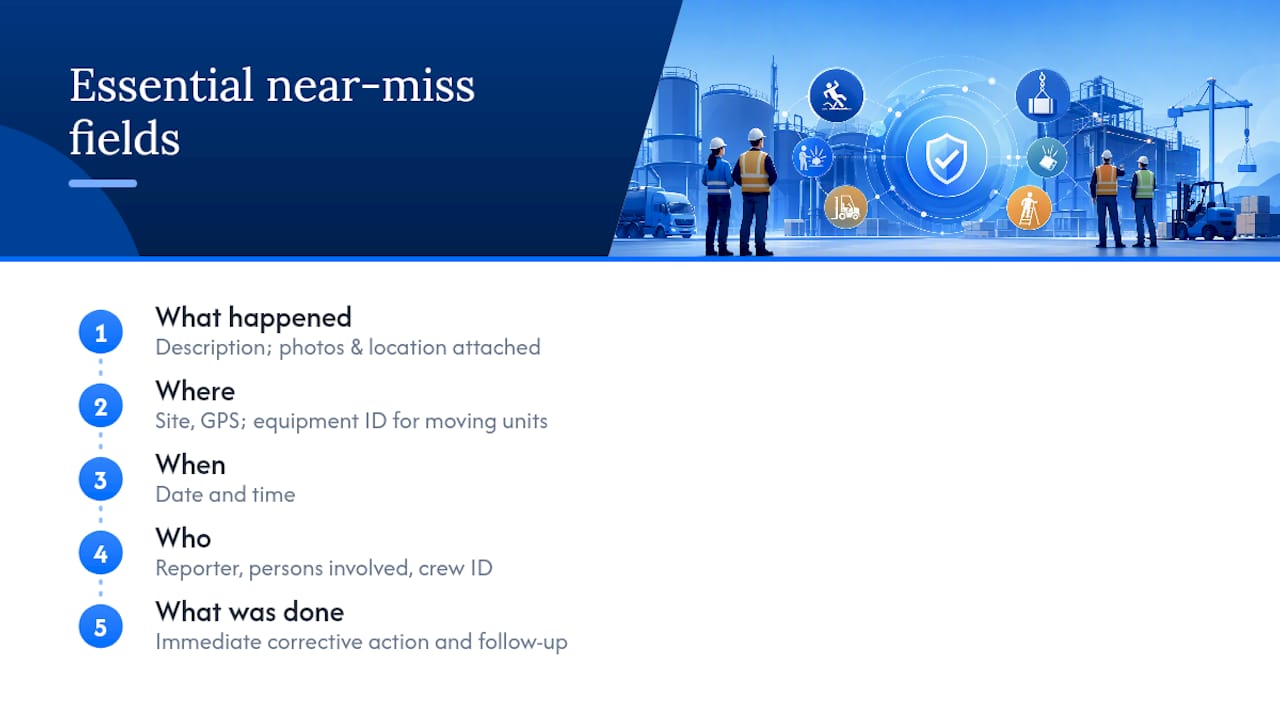
For rapid mobile entry, a minimal version works just as well: what happened, where, when, who was involved, and what was done immediately. Five fields, filled in from a phone within minutes. Add photos, equipment IDs and GPS coordinates whenever plant, vehicles or fixed assets are involved. The TAL/WSH Council guide to near-miss reporting provides a template annex if you want a starting structure rather than building one from scratch.
How do you investigate and follow up on a near miss?
Investigation should ask what might have happened, not just what did. That framing shifts the conversation from blame toward system design.
- Ask whether the environment (scheduling, tooling, layout) made the unsafe act the easy option, rather than assuming carelessness.
- Match the investigation depth to the potential severity. A minor near miss needs a quick check; a high-potential one needs a formal root-cause analysis.
- Apply the hierarchy of controls when choosing corrective action. Elimination and substitution beat administrative fixes like extra signage.
Track a handful of KPIs to know whether the programme is working: reports investigated within target timeframe, high-potential rate as a share of total reports, and corrective-action closure rate. Prioritising high-potential events for full analysis keeps investigators focused where the payoff is greatest.
Pro Tip: If every report gets the same investigation treatment, your best investigators burn out on trivial cases while the serious ones wait in the queue.
How do you get workers to actually report near misses?
Reporting rates rise or fall almost entirely on how supervisors respond to the first few reports. Thank the reporter, never interrogate them in front of colleagues, and close the loop with a visible update on what changed.
- Say thanks publicly (or at least genuinely) when someone reports, rather than treating it as an admission of fault.
- Give feedback within days, not weeks, showing what action was taken.
- Keep the form short enough to complete in under two minutes on a phone.
- Offer an anonymous option for workers who are hesitant, with a clear path for follow-up.
- Cover near-miss reporting in induction, not as an afterthought six months in.
The National Safety Council points to leadership behaviour, not form design, as the biggest lever on reporting volume. Run a five-minute toolbox talk each month reviewing recent near misses and what came of them.
What tools work best for capturing near-miss reports?
Paper forms are cheap and always available, but they get lost, delay data entry, and rarely capture photos or GPS. Spreadsheet logs improve searchability but still rely on someone manually transcribing field notes, which introduces gaps and delays. Mobile apps solve both problems: reports go in from the site in real time, with photos and location attached automatically, and nothing waits for someone to get back to the office.
The minimal field template still applies here: what happened, where, when, who, and what was done. A crew operating trucks or plant benefits most from a mobile option, since equipment IDs and GPS tagging matter more when the “location” is a moving vehicle rather than a fixed desk.
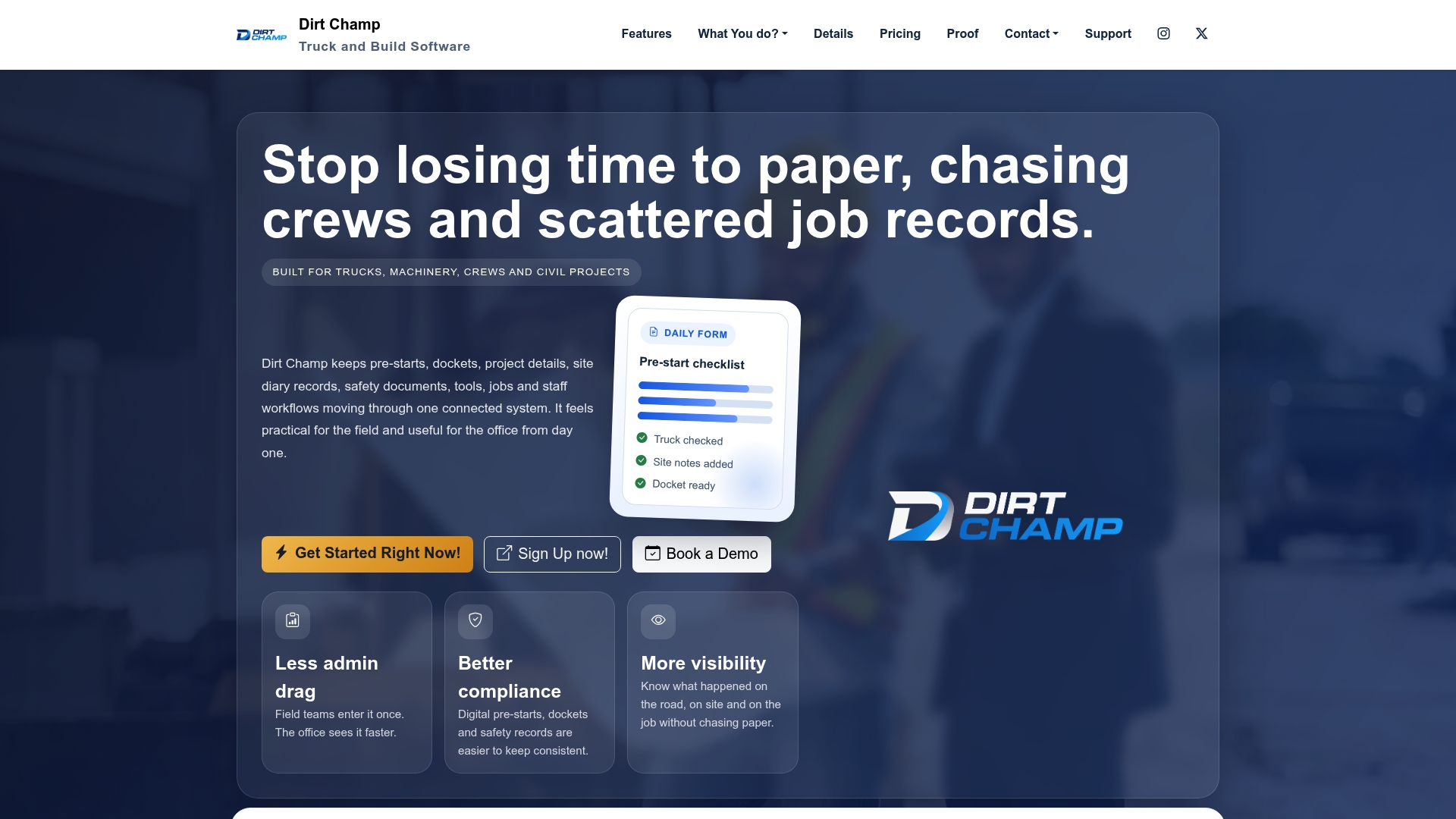
Dirtchamp was built for exactly this kind of field reporting. It lets crews log a near miss from a phone in the cab or on site, automatically stamps the location using GPS, and feeds the record straight into compliance and project files instead of a drawer full of paper. For truck and civil teams juggling multiple sites, that turns a two-minute mobile entry into an audit-ready record without extra admin.
How do you train workers to spot and report near misses?
Training works best when it’s specific to the tasks people actually perform, not a generic safety lecture. Show real examples from your own site, not hypothetical ones from a textbook, so workers recognise the pattern next time it happens in front of them.
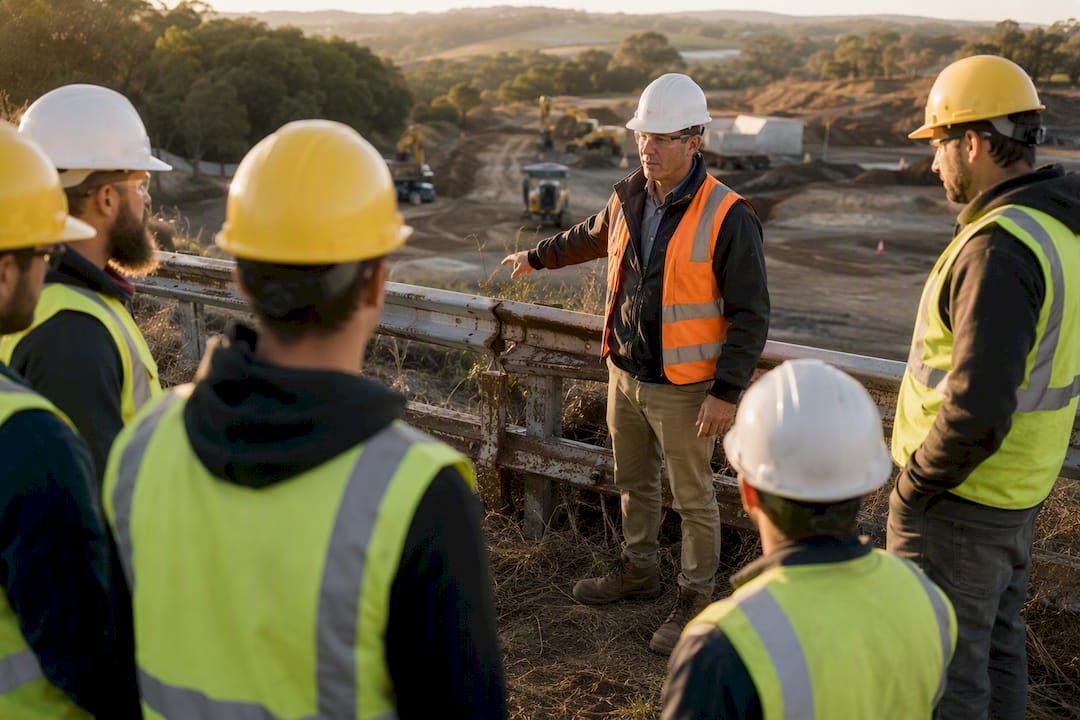
Build near-miss awareness into induction from day one. New starters who learn the reporting process alongside their first site orientation report at higher rates than those who get a form handed to them months later, according to guidance from the WSH Council’s near-miss reporting guide. Reinforce it through short, regular toolbox talks rather than annual refreshers.
Communication matters as much as training content. Supervisors who visibly discuss near misses in team briefings, without naming and shaming, normalise reporting as part of the job rather than an exception. Share the corrective action that came from a previous report, so workers see the process actually changes something.
Make identification easier by giving workers concrete categories to look for: near-collisions, structural or equipment failures that didn’t cause damage, near-falls, and control failures that were caught in time. A worker who understands these categories will flag events they might otherwise dismiss as “nothing happened, so why mention it.”
Consider running a short refresher whenever equipment, tasks or site layout changes significantly. New machinery or a reconfigured yard introduces hazards nobody has learned to spot yet, and that’s precisely when near misses spike.
How does near-miss reporting fit into your broader safety system?
Near-miss reporting only earns its value when it feeds into the rest of your safety management system rather than sitting in an isolated form. ISO 45001 treats near misses as part of the same incident data stream as accidents, meaning they should flow into the same review, audit and corrective-action processes.
Practically, that means every near-miss report should link to your hazard register, your risk assessments and your corrective-action tracker. If a report identifies a hazard that isn’t already on the register, add it. If a corrective action from a near miss changes a procedure, that change needs to show up in the next toolbox talk and the next induction session.
Integration also means near-miss data should appear in management review, not just supervisor logs. Safety committees and leadership meetings that only discuss actual injuries are working from incomplete data. A site with zero injuries but fifty unreported near misses isn’t safe, it’s lucky.
Software that connects field reporting to compliance records makes this integration far easier than juggling separate spreadsheets for pre-starts, incident logs and hazard registers. When a near-miss report, a vehicle pre-start check and a compliance document all live in the same system, patterns surface faster and nothing falls through the gap between departments.
What stops people from reporting near misses, and how do you fix it?
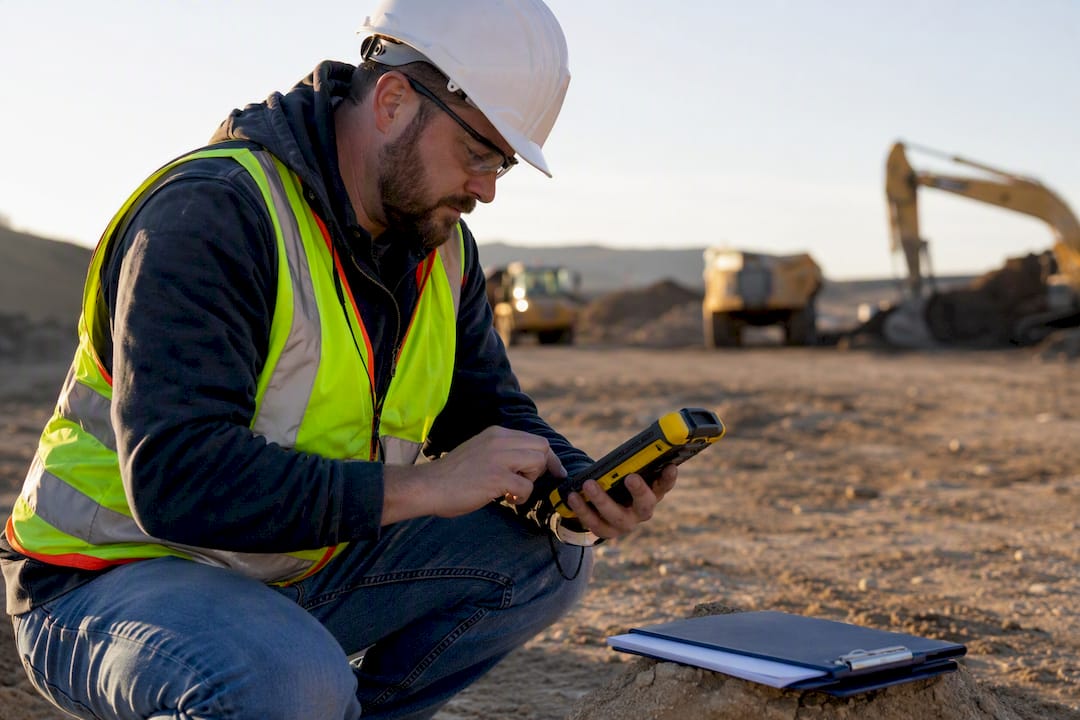
The biggest barrier is psychological, not procedural. Workers who fear blame, ridicule or disciplinary action will simply stay quiet, according to the National Safety Council. No form redesign fixes that on its own.
Time pressure is the second major barrier. If reporting takes fifteen minutes of paperwork mid-shift, most workers will decide it’s not worth the interruption, especially for what feels like a “minor” event. Cutting the report to a handful of fields, completed from a phone, removes most of that friction.
A third barrier is the perception that nothing happens with the report anyway. If workers submit near misses and never hear what came of them, they stop bothering. Closing that loop with a quick update, even a one-line message, is often the single biggest lever supervisors have.
Language and literacy barriers matter too, particularly on multicultural crews. Forms with plain wording, simple categories and optional photo-only submissions lower the barrier for workers less comfortable writing detailed English descriptions.
Fix these in order: leadership tone first, form simplicity second, feedback loops third. Skipping straight to a new app while supervisors still respond to reports with blame will not move the reporting rate.
Where to find more guidance on near-miss reporting
- OSHwiki near misses — the ISO 45001 aligned definition and analysis approach.
- National Safety Council — practical culture-building advice for supervisors.
- UniSC reporting guidelines — receiver and backup role guidance.
- TAL/WSH Council guide — sample templates and training components.
- WorkSafe Queensland — thresholds for notifiable incidents.
What actually moves the needle on near-miss reporting
Most advice on this topic obsesses over form design, and it’s the wrong place to start. A beautifully designed form handed to a workforce that fears blame will collect nothing. The evidence points the other way: leadership behaviour, specifically how a supervisor responds to the first report, decides whether a second one ever arrives.
The other place conventional guidance falls short is treating every near miss as equally worthy of investigation. It isn’t. A worker fumbling a tool that clatters harmlessly to the ground doesn’t need the same root-cause rigour as a load swinging near a powerline. Spreading investigation effort evenly burns out your best people on trivial cases while the genuinely dangerous patterns go under-examined.
If you take one thing from this guide, prioritise speed and simplicity over completeness. A five-field mobile report filed in the moment beats a comprehensive form filled in three days later from memory, every time. Get the immediate actions right, escalate the high-potential events fast, and let the paperwork follow the process rather than gate it.
Get near-miss reporting off paper and onto the phone
Dirtchamp gives truck and civil crews a way to log a near miss in under two minutes from the cab or the yard, without chasing down a paper form later or re-typing notes into a spreadsheet back at the office. Every entry gets GPS stamped automatically, so location and timing are locked in the moment it’s filed, and it sits alongside your pre-starts, dockets and compliance records instead of living in a separate system nobody checks.
That matters most for supervisors juggling multiple sites, where a near miss on one job can easily slip through if reporting depends on someone remembering to fill in a form days later. If your crews are already tracking machinery and dockets on mobile, adding near-miss capture to the same workflow is a small step with a real payoff in audit-ready records. Take a look at how Dirtchamp handles field reporting and see whether it fits how your teams already work.
Frequently asked questions about near-miss reporting
What is the difference between a near miss and an incident? A near miss causes no harm despite the potential; an incident or accident results in actual injury, illness or damage. The outcome, not how close the call was, decides the classification.
Does every near miss need to be reported to a regulator? No. Most near misses are managed internally through your own safety system. Only high-potential events classified as dangerous occurrences typically require external notification, and WorkSafe Queensland’s guidance sets out the threshold for that decision.
How quickly should a near miss be reported? Immediate safety actions happen on the spot. A formal written report should follow within 24 to 72 hours, and high-potential events should be escalated straight away rather than waiting for that window.
Who should receive near-miss reports on a worksite? A nominated receiver, with a backup for continuity, should collect every report so nothing depends on one person being available.
What is the biggest reason workers don’t report near misses? Fear of blame. A supervisor’s response to the first report, whether it’s gratitude or interrogation, shapes whether reporting continues.
Sources
- Near misses - OSHwiki | European Agency for Safety and Health at Work
- National Safety Council — Near-miss reporting resources
- Near-miss, hazard and incident reporting - Guidelines | UniSC
- Guide to near-miss reporting — WSH Council / TAL
- WorkSafe Queensland — Confirm if an incident is notifiable